
Why the UK Remains Exposed to Volatile Global Energy Markets
The UK’s energy security in 2026 and beyond is being tested again by the outbreak of hostilities involving Iran and the resulting disruption across global energy markets. Recent volatility has highlighted how exposed the UK remains to fluctuations in international oil and gas pricing, even without widespread physical shortages of fuel.
While the UK has largely avoided direct supply shortages, businesses and households remain heavily exposed to price volatility. UK electricity prices are still strongly influenced by gas fired power generation, meaning fluctuations in global gas markets continue to have a direct impact on energy bills. Oil price increases also continue to influence the wider economy, particularly transport and logistics costs.
Disruption and uncertainty surrounding the Strait of Hormuz, through which around 20% of global oil and LNG supply passes, has further intensified market concerns. Any restriction to this route has an immediate impact on wholesale pricing, supply chains and energy market confidence.
The impact is already being felt across the UK energy market. Many suppliers have increased fixed tariff pricing, while some products have been temporarily withdrawn as providers respond to wholesale market uncertainty. Although the Ofgem Price Cap continues to provide a degree of short-term protection for households, energy pricing remains subject to quarterly review and ongoing geopolitical pressure. Most businesses, however, remain directly exposed to wholesale electricity and gas market fluctuations, leaving many organisations increasingly vulnerable to rising energy costs.
How Solar Reduces Exposure to Global Energy Market Volatility
Global energy markets remain unstable and unpredictable, driven by geopolitical disruption, supply constraints and continued reliance on fossil fuels. In the UK, this volatility is most visible in residential and commercial electricity pricing, where wholesale costs remain closely linked to gas fired generation.
Solar energy provides a clear and proven way to reduce this exposure. Unlike fossil fuels, solar PV has no input fuel cost. Once installed, it delivers predictable, low cost electricity for decades, helping shield homes and businesses from fluctuations in global energy markets. By generating electricity on-site, homeowners and organisations can significantly reduce reliance on grid-supplied energy, particularly during peak pricing periods.
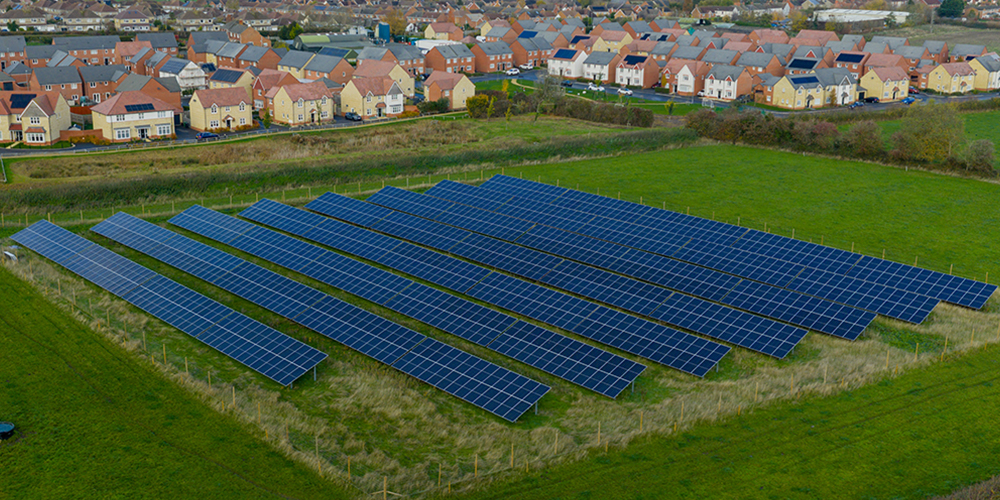
This is already being realised across the UK, particularly by energy-intensive sectors including manufacturing, data centres, education, and farming. For example, a 593 kWp solar PV installation for Berkeley Farm Dairy is projected to generate more than 642,400 kWh per year, supplying over 61% of the site’s total electricity demand and reducing electricity costs by approximately £88,000 per year. Over the next 25 years, this is expected to deliver more than £3.2 million in energy cost savings, reinforcing the long-term financial stability that on-site generation provides. In addition to reducing reliance on grid electricity, the commercial solar PV system is expected to reduce the site’s CO₂ emissions by more than 136 tonnes each year, supporting the organisation’s wider sustainability and ESG objectives.
Integrating a solar PV system with battery storage enables homes and organisations to extend the use of solar energy beyond daylight hours, further reducing reliance on grid electricity and exposure to price volatility. Excess energy generated during the day can be stored and used during peak pricing periods, enabling a more proactive approach to energy management. Many solar battery systems also provide real-time insight into energy usage and on-site generation, allowing users to optimise performance, increase on-site consumption and reduce exposure to peak pricing periods.
At the Western Provident Association (WPA) headquarters, a solar PV and commercial battery storage system enables energy to be monitored and managed in real time while maintaining continuity of supply during power disruptions. Over the next 25 years, the renewable energy system is expected to deliver around £1.2 million in energy cost savings, whilst reducing annual CO₂ emissions by over 136 tonnes.
Clare Sampson, Head of Operations at WPA, commented: “It’s been a significant step forward for us, improving efficiency, reducing emissions and reinforcing our commitment to sustainability.”
This integrated approach can also support on-site EV charging, extending the role of solar PV in reducing exposure to global energy markets beyond electricity and into transport. Solar and stored energy can be used to power electric vehicles, reducing reliance on imported oil and exposure to global fuel markets.
While EVs remove dependence on oil, they shift energy demand onto electricity, which can still be subject to volatility if sourced from the grid. However, when EV charging is powered by solar energy, this dependency is significantly reduced. Businesses can charge vehicles using self-generated electricity, lowering operating costs and reducing exposure to both oil and gas market fluctuations.
Solar carports play a key role in this transition, transforming existing parking infrastructure into a source of renewable energy. By generating power at the point of use, they enable efficient, scalable EV charging, particularly for commercial and industrial sites where rooftop capacity has already been maximised. A growing number of organisations are now investing in solar carports as part of wider energy resilience and decarbonisation strategies, particularly across sectors with large vehicle fleets and high daytime electricity demand such as leisure centres, airports and major engineering and manufacturing sites.


The Growth of the UK Solar Market
Despite ongoing global instability, the UK solar sector continues to experience rapid growth. March 2026 recorded the highest monthly level of solar installations since 2012, with more than 27,000 systems installed across the UK in a single month. The milestone also saw the UK surpass two million total solar installations for the first time, highlighting the accelerating demand for renewable energy across residential, commercial and industrial sectors.
Industry forecasts indicate around 5 GW of new solar capacity could be added over the next 12 months, with commercial rooftop, residential and large-scale ground-mounted solar projects all forecast to expand significantly.
Russell Mees, Managing Director at SolarSense, commented:
“The UK’s electricity mix is evolving rapidly. Recent figures showed solar generation accounting for around 35% of the UK’s electricity consumption at one point during a new national generation record, demonstrating the growing role renewable energy is now playing while reliance on fossil fuels continues to decline.
As the UK continues working towards greater energy security, developments like this show that we are moving in the right direction. Increasing solar and wind generation will help reduce exposure to volatile fossil fuel markets, support lower long-term electricity costs and strengthen the UK’s energy independence.”
As deployment continues to scale, solar PV is becoming an increasingly important component of UK energy resilience. Combined with battery storage and EV charging infrastructure, decentralised renewable energy systems are helping homes and organisations gain greater control over long-term energy costs while reducing exposure to global energy market instability.
Energy Security and Market Outlook
The Iran conflict has highlighted the UK’s continued exposure to volatile international fossil fuel markets, particularly in relation to gas pricing and wider energy costs. While renewable energy alone cannot currently replace every aspect of conventional energy infrastructure, the continued deployment of solar PV and battery storage is already helping reduce peak demand, improve energy resilience and lower reliance on imported fossil fuels.
For homeowners and businesses alike, solar is no longer simply an environmental decision. It is increasingly becoming a long-term energy security strategy, enabling greater cost certainty, operational resilience and protection against future market disruption.