
Solar carports are used to massively enhance current parking spaces for your premises. You can provide parking that you can then monetise, or provide EV charging stations or charge points, as well as create established car parking spaces that generate electricity for your business. This resource is an essential guide to designing and installing a solar carport, providing you with guidance on what you will need to consider, whether a solar carport solution is right for you and your business, and all of the considerations that you need to make.
| Category | Aspect | Incentives & Considerations |
| Residential VAT & Tax | Currently at 0% VAT Rate | Residential carport installations enjoy 0% VAT until 31 March 2027. This includes the structure, panels, and integrated battery/EV chargers. This is from government incentives to promote the installation of ESMs. |
| Planning Permissions & Permitted Development | The 10m Rule | Commercial carports are often allowed under “Permitted Development” if they are at least 10 metres from any residential boundary. |
| Planning Permissions & Permitted Development | Height & Limits | Domestically, carports usually fall under Class E (outbuildings). Max height is 4m (dual pitch) or 2.5m if within 2m of a boundary. |
| Certifications & Accreditation | MCS Accreditation | Essential for accessing the Smart Export Guarantee (SEG). We are MCS-certified to provide you with these benefits and to ensure professional installation. We also handle the entire process for you, from the design of your systems to installation and aftercare. |
What is a Solar Carport System?
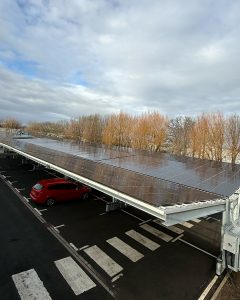
A covered parking structure with solar PV (photovoltaic) panels installed. Carports provide both the benefits of sheltered parking underneath with solar panels attached in an array to the top of the structure. This provides a dual function where you protect vehicles as well as generate electricity for the premises. This works for both domestic and commercial installations, with commercial buildings being able to install more structures across parking spaces that are available. If you are creating parking spaces, you can also consider solar carport installation when you construct these new spaces.
EV charge points are often integrated and installed into the systems or in some of the systems to provide charging points for electric vehicles. This is great for homes where you want a dedicated parking space that can charge your EV. This will effectively provide extremely cheap and eventually free charging for your EV. For businesses, you can choose whether to charge staff and visitors for the EV charge point or provide it without any costs. An app will be installed, as well as systems which allow you to integrate payment gateways, or you can choose to keep the charge point free of charge.
How Does the System Work?
The carports or canopies that protect the vehicles are designed and then installed with high-quality materials. We design the structures using the available space that you have, and we can also design them to be installed alongside a parking area if this is being terraformed/installed. These structures then protect your vehicles from the elements.
The solar PV panels are installed above the carports or canopies, and they are additional solar panels that generate electricity for the premises or the property. You can use this to power the EV charge points directly, store in a solar battery if one is installed for later use, or it can be used to power other buildings diverted away from the system (such as being combined with the electricity generated from roof-mounted solar panels). They generate electricity by passing sunlight through the PV cell, which excites the electrons and releases them from their bonds. DC can be stored in the battery directly or converted to AC to power properties. DC is also used to power electric vehicle batteries, so you can directly charge the batteries from DC generated from the photovoltaic process.
Commercial Installations – Are My Premises Suitable?
You will need a parking space or land that you are able to convert into parking to be able to install a range of solar carports or canopies. Changing land use typically requires planning permission from your local authority, but we are also experienced in supporting projects where land is being converted into parking, where we can then install your carports alongside this. If you have parking already available, this will typically fall under permitted development, as the land is already being used for parking specifically. Then you can carry out the design and installation.
Domestic Installation – How Can I Benefit from My Home or Property
If you have an electric vehicle, then you will want to have a charge point at home. So, home solar carports are a great combination with an EV charge point to charge your vehicle. If you have a parking space and want to upgrade to a canopy, then we can design and install this, and it’s a great upgrade for your property, which is also known to add to the overall value of the property. You are also generating more electricity from your solar panels, as it’s another area where solar panels can be installed apart from your roofspace.
Incentives for Installation
For domestic installations, you are covered by a 0% VAT exemption until 31st March 2027. This has made installation cheaper, so you are able to make a faster return on your investment in terms of payback. If you have an EV charge point, you can charge your electric vehicle directly.
Payback & ROI
The payback period will depend on the size of your array and the number of car ports that you are able to install, with typical payback periods ranging from 5 to 15 years. The structures are durable and will last for many years, often up to 50 years before needing replacement. Commercial installations will make faster returns due to the number of carports that can be installed and the high energy requirements for home systems.
Is a Parking Canopy the Same Thing?
Yes, solar carports are also called solar parking canopies. They are the same structure; this is just another term that is used for carports.