
From ESG Ambition to Real-World Delivery
Over the past five years, Environmental, Social, and Governance (ESG) has accelerated dramatically. Organisations across the UK are publishing sustainability strategies, committing to carbon reduction targets and developing formal ESG energy strategies to align with investor, customer and regulatory expectations. Yet for many businesses, the biggest challenge is turning those ambitions into measurable, practical action.
Boards are asking:
- Where do we start?
- What delivers real, measurable impact?
- How do we act to maximise growth?
- Which investments deliver both environmental and financial return?
Why Energy Is Emerging as the First Step in an ESG Strategy
Electricity sits at the heart of operations across manufacturing, logistics, property and commercial sectors. It is one of the largest contributors to Scope 2 emissions and one of the most volatile operational costs businesses face. As a result, on-site renewable energy is becoming central to both net zero energy strategies and broader ESG renewable energy programmes for businesses.
SolarSense has spent more than three decades delivering commercial solar installations in the UK, helping organisations deploy commercial solar panels, battery storage for businesses and solar carports as part of long-term decarbonisation plans.
Crucially, the financial case has strengthened dramatically in recent years. Solar electricity can now typically be generated at around 4–6p per kWh, compared with grid electricity that often costs 20–30p per kWh for UK businesses. When combined with battery storage, organisations can increase on-site consumption, reduce grid reliance and improve energy resilience. This combination makes commercial solar ESG strategies both environmentally impactful and financially compelling.
Reducing Scope 2 Emissions Through Commercial Solar and Battery Storage
For organisations seeking to reduce Scope 2 emissions, on-site solar PV remains one of the most immediate and measurable solutions available. Commercial solar panels for manufacturing facilities, distribution centres and large commercial properties enable businesses to:
• Reduce reliance on grid electricity
• Cut operational carbon emissions
• Improve ESG reporting metrics
• Strengthen supply chain credentials
• Enhance long-term cost certainty
Commercial ESG in Action
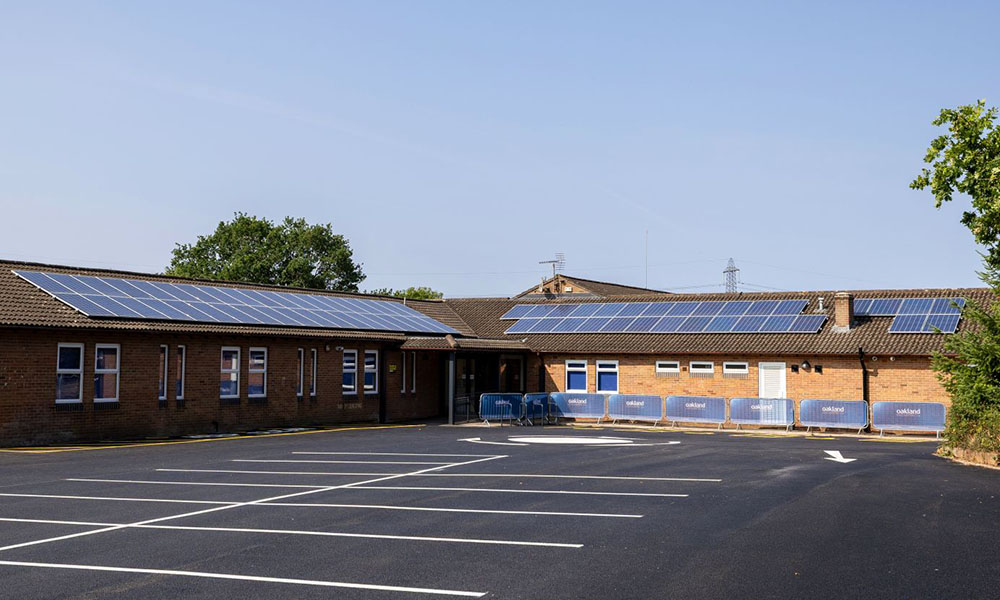
A strong example of ESG delivered through on-site renewable energy can be seen in SolarSense’s partnership with UK meals manufacturer apetito. SolarSense delivered a 1.3MWp commercial solar installation at the organisation’s manufacturing facility, combining rooftop arrays and solar carports to support its net zero and ESG strategy.
The system includes more than 2,800 solar panels and is expected to generate around 1.19 million kWh of clean electricity each year. The project is forecast to cut carbon emissions by approximately 248 tonnes of CO₂ annually and generate lifetime electricity savings of more than £6.4 million.
As part of the renewable energy upgrade programme, SolarSense ensured the responsible reuse of decommissioned solar panels from a legacy system. These solar panels were donated to South West charity Paul’s Place, extending the social value of the project and reinforcing how commercial solar and ESG projects can deliver environmental and community impact simultaneously.



Funding the Transition to Clean Energy
Historically, capital expenditure has been a barrier to deploying business solar panels and battery storage. Today, modern funding structures have removed that constraint. Businesses can now deploy solar panels, solar carports, EV charging and battery infrastructure with no upfront CapEx, using structured funding models that align repayments with energy savings.
In most cases, the reduction in electricity spend exceeds the monthly funding cost, allowing renewable energy projects to generate immediate savings and be cash positive from day one.
With typical payback periods of three to five years and system lifespans measured in decades, clean energy is increasingly being embedded into mainstream capital planning as a self-funding strategic asset. For organisations ready to turn ESG ambition into measurable action, the next step is understanding what energy could deliver for their business.